Better Decisions, Higher Yields: The Growing Role of Artificial Intelligence in Agriculture
Artificial intelligence is starting to play a concrete role in Argentine agriculture, helping turn scattered data into operational decisions. Through agentic AI, AI agents integrate with the systems farmers and agribusinesses already use to automate tasks, build traceability, and improve production management. In this article, we look at how this approach connects with the work we do at Laburen to apply artificial intelligence to real agricultural processes.
Agricultural production today operates in a scenario where every decision counts. Climate variability, input costs, and the need to make better use of every hectare demand working with accurate, real-time information.
The challenge is structural: according to the FAO, the planet will add between 1 and 1.5 billion people over the next 25 years. That will require increasing food production at a rate of close to 3% per year. Producing more without expanding acreage means reducing errors and making better decisions every season.
In this context, artificial intelligence is starting to take on a concrete role in production management. Agriculture generates data constantly (planting records, applications, weather, yields, inventory, and logistics), but much of that information remains scattered across spreadsheets and systems that don't talk to each other.
The problem isn't a lack of data. It's the difficulty of turning it into operational decisions.
At Laburen, we develop agentic AI solutions designed to integrate with the systems that farmers and agribusinesses already use. Our agents work as AI employees within real workflows: they're not isolated tools, but part of the operation.
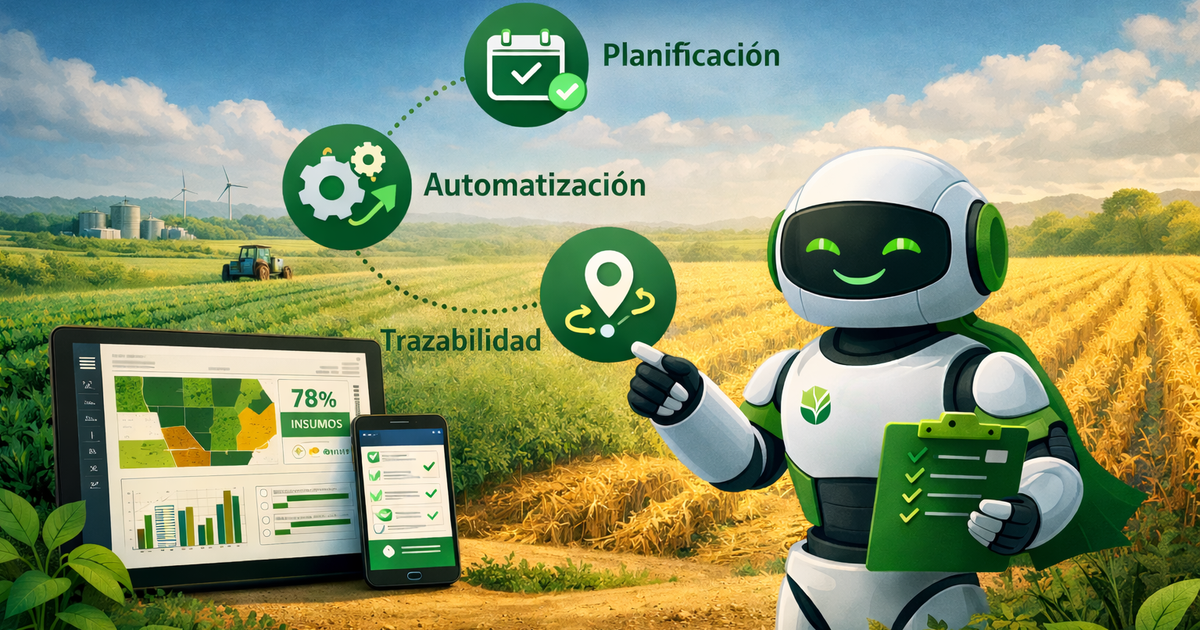
These agents can enter and validate season data, consolidate information from different fields, update input inventory, generate technical and financial reports, track production, and support planning without adding administrative workload.
One of the most significant impacts is traceability. By operating directly on processes, the agents automatically record what was done, when, and with which inputs. Traceability stops being an after-the-fact requirement and becomes a natural part of management, making it possible to review decisions, compare seasons, and adjust practices with organized, consistent information.
“AI no longer stays in the analysis stage. Agents work on real processes, automating tasks and organizing information to turn data into operational judgment,” explains Sebastián Rinaldi, founder of Laburen.
Getting started isn't complicated: identify repetitive tasks (data entry, season tracking, report generation) and apply intelligent automation at those points. From there, AI is integrated progressively and starts to have a real impact on production efficiency.
At Laburen, we work to apply artificial intelligence to real-world agriculture, turning scattered data into operational decisions, season after season.
Want to add AI employees to your company?
Talk to our team and discover how we can help you implement AI solutions.